
Views: 0


Choosing the right soy sauce filling machine or vinegar filling machine is an important decision for food manufacturers planning to establish a new bottling plant or upgrade an existing production line.
Soy sauce and vinegar are widely packaged in glass bottles because glass provides good product protection, chemical resistance, and an attractive appearance for retail packaging.
However, filling liquid condiments into glass bottles requires more than selecting a machine with sufficient production speed. Manufacturers must consider product characteristics, filling accuracy, bottle handling, capping technology, hygiene requirements, and complete production line integration.
Different filling technologies, including piston filling, gravity filling, and flowmeter filling, offer different advantages depending on the liquid and packaging requirements.
In this guide, PESTOPACK explains how to choose suitable filling and capping equipment, compare filling technologies, understand complete bottling line configurations, and evaluate the factors affecting equipment investment.
Whether you are packaging soy sauce, vinegar, or other compatible liquid condiments, this guide will help you identify a suitable automated filling solution.
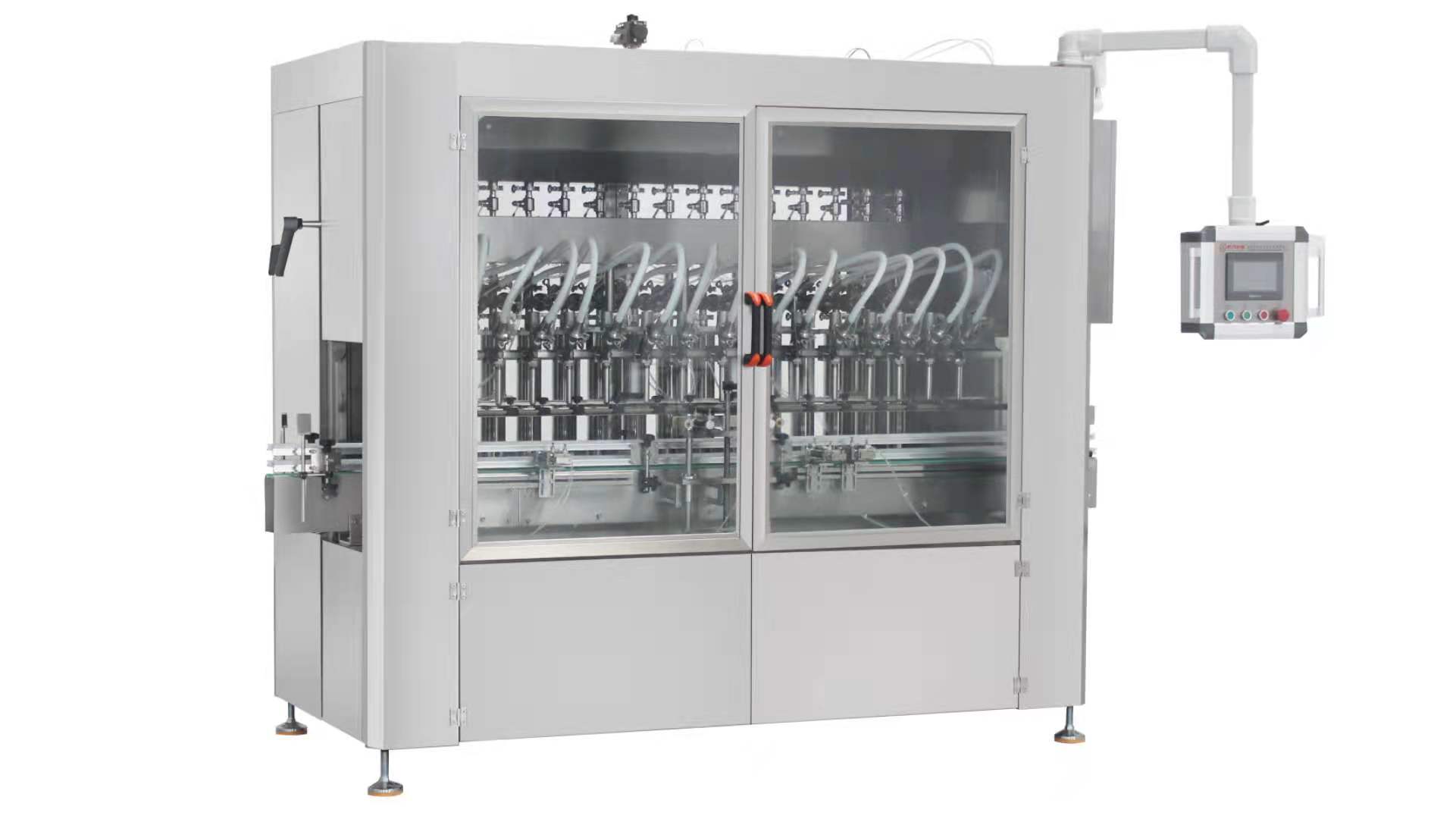
A soy sauce filling machine is industrial packaging equipment designed to dispense measured quantities of soy sauce into containers such as glass bottles or plastic bottles.
Similarly, a vinegar filling machine is designed to handle vinegar products while maintaining appropriate filling accuracy and compatibility with the liquid.
Depending on the production requirements, filling machines may operate using piston dosing, gravity filling, flowmeter measurement, or other suitable technologies.
An automatic filling system typically performs the following operations:
Empty bottles enter the filling station through a conveyor.
Sensors detect and position the bottles.
Filling nozzles dispense the required volume of liquid.
The control system manages the filling cycle.
Filled bottles move to the next packaging station.
Automatic filling machines help reduce repetitive manual operations and support consistent production.
For manufacturers requiring higher levels of automation, automatic liquid filling machines can be integrated with bottle rinsing, capping, labeling, coding, and packaging equipment.
The most suitable configuration depends on the product characteristics, required capacity, packaging format, and available factory space.
Although soy sauce and vinegar are both liquid condiments, their physical and chemical characteristics can influence filling machine selection.
Understanding these factors helps manufacturers avoid equipment compatibility problems and unnecessary production interruptions.
Soy sauce and vinegar are generally free-flowing liquids compared with thick sauces such as ketchup or mayonnaise.
However, viscosity may vary depending on product formulation, temperature, and ingredients.
A suitable filling machine should provide controlled liquid flow to reduce splashing, dripping, and product waste.
For lower-viscosity liquids, gravity filling and certain flowmeter filling systems may be suitable.
Piston filling machines can also be considered when their volumetric dosing characteristics and product-contact components match the application.
Soy sauce commonly contains salt, while vinegar contains acetic acid.
These characteristics make material compatibility an important consideration.
Manufacturers should evaluate the materials used in:
Filling tanks and pipelines.
Filling cylinders and valves.
Filling nozzles.
Sealing components and gaskets.
Other product-contact surfaces.
SUS304 and SUS316L stainless steel are commonly used in food processing equipment.
However, the appropriate material grade must be selected according to the actual product composition, concentration, temperature, cleaning chemicals, and operating conditions.
A material suitable for one soy sauce or vinegar formulation may not automatically be suitable for every formulation.
Some liquid products may generate foam or splash during high-speed filling.
Excessive splashing can affect filling accuracy, contaminate bottle surfaces, and increase cleaning requirements.
Depending on the product and equipment design, manufacturers may consider:
Adjustable filling speed.
Anti-drip filling nozzles.
Suitable nozzle diameter.
Controlled filling profiles.
Bottom-up filling where appropriate.
The final filling configuration should be confirmed through product testing.
Glass bottles require careful handling during conveying, filling, and capping.
Bottle dimensions, weight, neck finish, and shape can influence equipment performance.
Important considerations include adjustable conveyor guide rails, bottle positioning, filling nozzle alignment, and stable bottle transfer.
For manufacturers handling multiple bottle formats, the machine should also support practical changeover procedures.
Several filling technologies are available for liquid condiment packaging.
The most suitable technology depends on product viscosity, filling volume, required accuracy, production capacity, and budget.
A piston filling machine uses a piston-cylinder mechanism to draw liquid into a measuring chamber and dispense a controlled volume into the bottle.
The filling volume is determined by piston displacement.
Piston filling is commonly considered for products requiring positive-displacement volumetric dosing.
Advantages of piston filling machines:
Adjustable filling volume.
Suitable for a range of compatible liquid viscosities.
Positive-displacement dosing.
Multiple filling-head configurations.
Integration with automatic production lines.
Factors to consider:
Compatibility of pistons, cylinders, valves, and seals.
Cleaning and maintenance requirements.
Product viscosity and temperature.
Filling accuracy under actual operating conditions.
Required production capacity.
For liquid condiment manufacturers, a piston filling machine may provide a suitable solution when the product characteristics and machine design are compatible.
PESTOPACK also provides sauce filling machine solutions for different liquid and semi-liquid food packaging requirements.
Gravity filling machines use the liquid's own weight to support the filling process.
This technology is commonly considered for free-flowing, low-viscosity liquids.
Advantages:
Relatively simple operating principle.
Suitable for certain thin liquid products.
Potentially economical for appropriate applications.
Straightforward mechanical configuration.
Considerations:
Filling performance depends on liquid flow characteristics.
Accuracy varies according to the machine design.
Some applications require additional flow control.
Not every product is suitable for gravity filling.
Flowmeter filling machines measure liquid flow and control the amount dispensed into each container.
Different flowmeter technologies are available, including electromagnetic and mass-flow measurement systems.
The appropriate technology depends on the liquid's electrical conductivity, viscosity, temperature, and other relevant characteristics.
Advantages:
Electronic filling volume control.
Convenient parameter adjustment.
Integration with automatic control systems.
Suitable for compatible liquid applications.
Considerations:
Sensor compatibility with the product.
Calibration requirements.
Product characteristics affecting measurement.
Equipment and maintenance costs.
Filling Technology | Typical Applications | Main Advantages | Key Considerations |
|---|---|---|---|
Piston filling | Compatible liquid condiments and sauces | Positive-displacement volumetric dosing | Seals, cleaning, product viscosity |
Gravity filling | Free-flowing, low-viscosity liquids | Simple operating principle | Flow control and dosing requirements |
Flowmeter filling | Compatible liquids requiring electronic volume measurement | Electronic volume control | Sensor selection and calibration |
PESTOPACK Recommendation: Do not select a filling machine based only on its advertised speed or filling technology. Evaluate the actual product, bottle specifications, cleaning requirements, and complete packaging process before making a decision.
An automatic piston filling machine can be integrated with glass bottle conveying and capping equipment to create a more automated liquid condiment packaging process.
PESTOPACK provides piston filling equipment configurations for suitable liquid products, including soy sauce, vinegar, and other compatible condiments.
Empty glass bottles enter the filling station through an automatic conveyor.
The bottle positioning system aligns the containers beneath the filling nozzles.
The piston dosing mechanism then dispenses the preset volume of liquid into each bottle.
Once the filling cycle is completed, the bottles move along the conveyor toward the capping station.
The filling system can be configured according to the required production capacity, bottle specifications, and product characteristics.
Consistent volumetric dosing
Piston filling systems use positive-displacement measurement to control the filling quantity.
Adjustable filling parameters
Filling volume and operating parameters can be configured within the machine's specified adjustment range.
Automatic bottle conveying
Integrated conveyors help reduce manual bottle transfer between packaging stages.
Flexible machine configurations
The number of filling heads, filling volume range, and machine structure can be selected according to the project requirements.
Integration with downstream equipment
Automatic piston filling machines can be connected to compatible capping, labeling, and packaging systems.
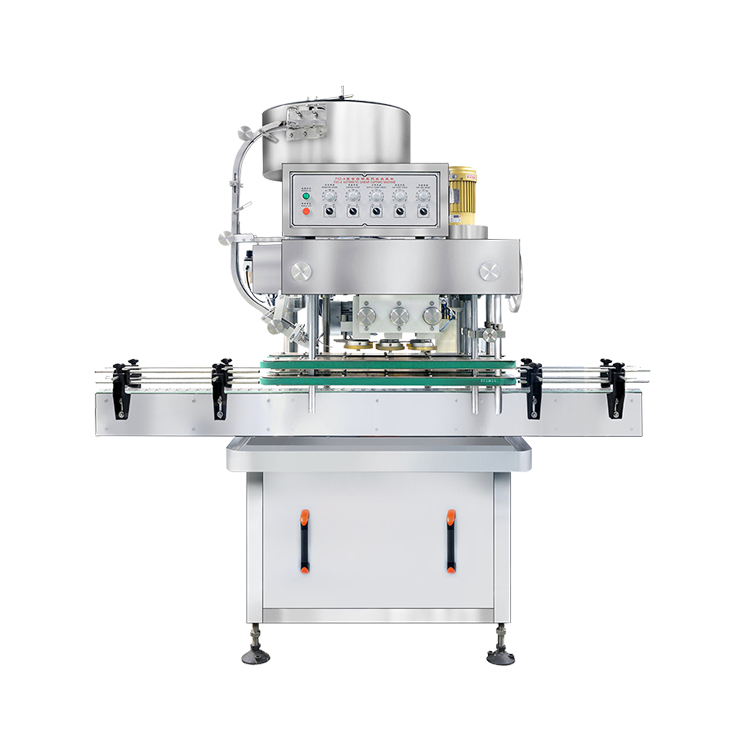
The capping machine is an essential part of an automatic soy sauce or vinegar bottling line.
After filling, bottles must be closed securely to protect the packaged product and reduce leakage during storage and transportation.
Different glass bottle closures require different capping mechanisms.
Glass bottles used for liquid condiments may use:
Plastic screw caps.
Metal screw caps.
Tamper-evident closures.
Press-on caps.
Other specialized closures.
A screw-capping machine applies rotational torque, while a press-on capping machine applies a controlled closing force.
The appropriate equipment depends on the bottle neck finish and cap design.
Cap feeding system
Depending on the production requirements, caps may be supplied manually or through an automatic sorting and feeding system.
Bottle positioning
The bottle holding mechanism should maintain stable positioning during the capping process.
Closing performance
The machine must apply the required torque or closing force according to the cap specification.
Production capacity
The capping machine should match the actual output of the filling machine.
Changeover capability
If several bottle or cap formats are required, the machine may need adjustable mechanisms or dedicated change parts.
Actual bottle and cap samples help equipment manufacturers evaluate compatibility before production.
Sample testing can identify potential issues with bottle stability, cap feeding, closing force, and sealing performance.
For manufacturers considering an integrated solution, filling and capping machines can be configured according to the bottle and closure requirements.
A complete soy sauce filling line or vinegar bottling line may include several machines connected through an automatic conveyor system.
The exact equipment configuration depends on production capacity, bottle format, product characteristics, and desired automation level.
Empty glass bottles are introduced to the production line.
Depending on the required capacity, the system may use manual bottle loading, semi-automatic feeding, or automatic bottle handling equipment.
A bottle rinsing machine may be installed before the filling station.
The cleaning method should be selected according to incoming bottle conditions and the manufacturer's hygiene requirements.
The filling machine dispenses the required quantity of soy sauce or vinegar into each bottle.
The filling principle and machine configuration should be selected according to the liquid characteristics and production requirements.
Filled bottles move to the capping station, where the appropriate closure is applied.
The capping equipment should match the bottle neck, cap dimensions, and required production speed.
An automatic labeling machine applies the product label.
Depending on the bottle shape and label design, manufacturers may select front-and-back labeling, wrap-around labeling, or another suitable labeling configuration.
A coding machine prints or marks the required production information.
Typical information may include production dates, batch numbers, and traceability codes.
Finished bottles are packed into cartons for storage and transportation.
Packaging may be performed manually or through automatic carton packing and sealing equipment.
For higher automation requirements, a palletizing system may be added to handle finished cartons.
Production Process | Recommended Equipment |
|---|---|
Bottle feeding | Bottle feeding system |
Bottle preparation | Bottle rinsing machine, if required |
Filling | Automatic liquid filling machine |
Capping | Automatic capping machine |
Labeling | Automatic labeling machine |
Coding | Date or batch coding machine |
Secondary packaging | Carton packing and sealing machine |
Material handling | Conveyor and optional palletizing equipment |
Manufacturers can also explore sauce bottle filling machine solutions when planning a more complete liquid condiment packaging system.
Production capacity is one of the most important factors when selecting a soy sauce or vinegar filling machine.
The machine should meet the required production target while maintaining reliable operation and compatibility with downstream equipment.
Start by determining the expected daily production quantity and available operating hours.
For example, suppose a manufacturer plans to produce 16,000 bottles per day over an eight-hour production period.
The average required output is:
16,000 bottles ÷ 8 hours = 2,000 bottles per hour
However, actual production includes cleaning, adjustments, material replenishment, and possible downtime.
If an illustrative operating efficiency of 80% is assumed, the corresponding nominal equipment capacity would be:
2,000 ÷ 0.80 = 2,500 bottles per hour
This is an example for production planning, not a guaranteed performance specification for any particular machine.
Actual filling capacity depends on several factors:
Filling volume.
Product viscosity.
Filling nozzle design.
Filling cycle time.
Bottle positioning and indexing.
Conveyor performance.
Control system configuration.
Downstream equipment capacity.
A machine's output should be confirmed through technical specifications and testing under the intended operating conditions.
The overall production capacity is limited by the slowest process in the line.
For example, a high-speed filling machine cannot achieve its potential output if the capping or labeling machine cannot keep up.
Therefore, equipment capacity should be evaluated across the entire production line rather than for each machine independently.
The cost of a soy sauce filling machine or vinegar filling machine depends on the equipment design, technical specifications, and required automation level.
A standalone filling machine generally requires a different investment from a complete automatic bottling and packaging line.
Piston filling, gravity filling, and flowmeter filling systems use different mechanical components and control methods.
The appropriate technology should be selected according to the product rather than price alone.
The number of filling heads affects machine structure, component quantities, and production capacity.
However, machine price also depends on filling technology, control systems, and mechanical design.
Material requirements can influence equipment cost.
Manufacturers should confirm the compatibility of stainless steel, seals, gaskets, and other wetted components with the product.
Machines designed for multiple bottle and cap formats may require additional adjustment mechanisms, change parts, or tooling.
Optional equipment can include:
Automatic bottle feeding.
Bottle rinsing.
Automatic capping.
Labeling.
Coding.
Carton packing.
Carton sealing.
Palletizing.
PLC systems, HMI panels, sensors, servo motors, and electrical component brands can affect equipment cost and performance.
International projects may require freight, installation, commissioning, operator training, and spare parts.
These requirements should be clarified during the quotation process.
To obtain a customized quotation, prepare the following information:
Product name and characteristics.
Bottle volume and dimensions.
Bottle and cap photos or samples.
Required production capacity.
Desired automation level.
Available workshop space.
Electrical supply requirements.
Destination country.
Providing complete information helps the equipment supplier recommend a suitable configuration and prepare a more accurate quotation.
The lowest initial price does not always result in the lowest long-term operating cost.
Equipment compatibility, maintenance requirements, spare parts, and technical support should also be considered.
Different soy sauce and vinegar formulations may have different filling and material compatibility requirements.
Always provide accurate product information.
The filling machine must work together with capping, labeling, and packaging equipment.
Unbalanced equipment capacity can cause production interruptions.
Bottle dimensions and closure specifications must be confirmed before equipment manufacturing.
Physical samples are recommended for compatibility testing.
Food filling equipment should support appropriate cleaning and sanitation procedures.
Manufacturers should consider accessibility, cleaning methods, and product changeover requirements.
Testing with actual bottles, caps, and products can help identify potential problems before shipment.
Selecting the right equipment supplier is an important part of a successful bottling project.
A reliable manufacturer should be able to evaluate the customer's actual production requirements and recommend a technically suitable solution.
Look for suppliers with experience in liquid filling and packaging machinery.
Relevant experience can help with equipment selection, bottle handling, and line integration.
The supplier should consider product characteristics, bottle specifications, closure types, production capacity, and factory layout.
Ask whether the supplier can test the equipment using actual products, bottles, and caps.
Relevant machine specifications, operating instructions, and installation requirements should be available.
Confirm installation assistance, spare parts availability, operator training, and technical support arrangements before placing an order.
PESTOPACK supplies customized liquid filling and packaging equipment for different products and container types.
For soy sauce and vinegar bottling projects, we can evaluate:
Automatic piston filling systems.
Suitable alternative filling technologies.
Glass bottle conveying.
Automatic capping equipment.
Labeling and coding machines.
Complete packaging line integration.
Our objective is to help manufacturers select equipment that matches their actual production requirements.
The most suitable filling machine depends on product viscosity, formulation, bottle size, required capacity, and cleaning requirements. Piston, gravity, and compatible flowmeter filling technologies may be considered.
Yes, piston filling machines can be configured for compatible vinegar products. Product-contact materials and seals must be evaluated according to the actual formulation.
It may be possible if the filling system is compatible with both liquids. Appropriate cleaning and changeover procedures are necessary to prevent cross-contamination.
Depending on the machine configuration, soy sauce filling equipment may handle glass bottles, suitable plastic bottles, and other compatible containers.
Many automatic filling machines can accommodate different bottle sizes within a specified range. Adjustments or change parts may be required.
Filling accuracy depends on machine design, product characteristics, calibration, and operating conditions. The guaranteed accuracy should be confirmed through equipment specifications and testing.
The appropriate capping machine depends on the bottle neck finish and closure type. Different caps may require screw-capping, press-on capping, or another suitable mechanism.
Yes. A complete production line can integrate bottle feeding, rinsing, filling, capping, labeling, coding, carton packing, and other equipment.
The price depends on production capacity, filling technology, automation level, equipment configuration, and customization requirements. A detailed quotation requires actual project specifications.
PESTOPACK can evaluate customized filling and packaging solutions based on product characteristics, bottle specifications, production capacity, and factory requirements.
Selecting the right soy sauce filling machine or vinegar filling machine requires careful evaluation of the product, container, filling technology, capping system, and overall packaging process.
Piston filling machines can provide a suitable volumetric filling solution for compatible liquid condiments, while gravity and flowmeter filling technologies may offer advantages for other applications.
The best solution depends on the actual product formulation, required capacity, cleaning procedures, and complete production line configuration.
By selecting compatible equipment and coordinating the different packaging stages, manufacturers can develop a more reliable and efficient bottling operation.