Rotary vs Linear Oil Filling Machines: Which Is Better for Your Production Line?
Views: 0
Choosing between a rotary oil filling machine and a linear oil filling machine is an important decision when planning a new oil bottling plant or upgrading an existing production line.
Both systems can automate oil filling, improve production efficiency, and integrate with capping, labeling, and packaging equipment. However, they differ significantly in machine layout, operating principles, production capacity, changeover flexibility, and investment requirements.
For manufacturers packaging edible oils, engine oils, lubricants, and other liquid oil products, selecting the right equipment requires more than simply comparing filling speeds.
A linear oil filling machine is often a practical choice for small to medium production volumes, multiple bottle formats, and frequent product changes. A rotary oil filling machine is generally more attractive for high-volume production with standardized bottles and consistent operating conditions.
This guide compares the two technologies and explains how to select the right solution for your factory.
What Is a Linear Oil Filling Machine?
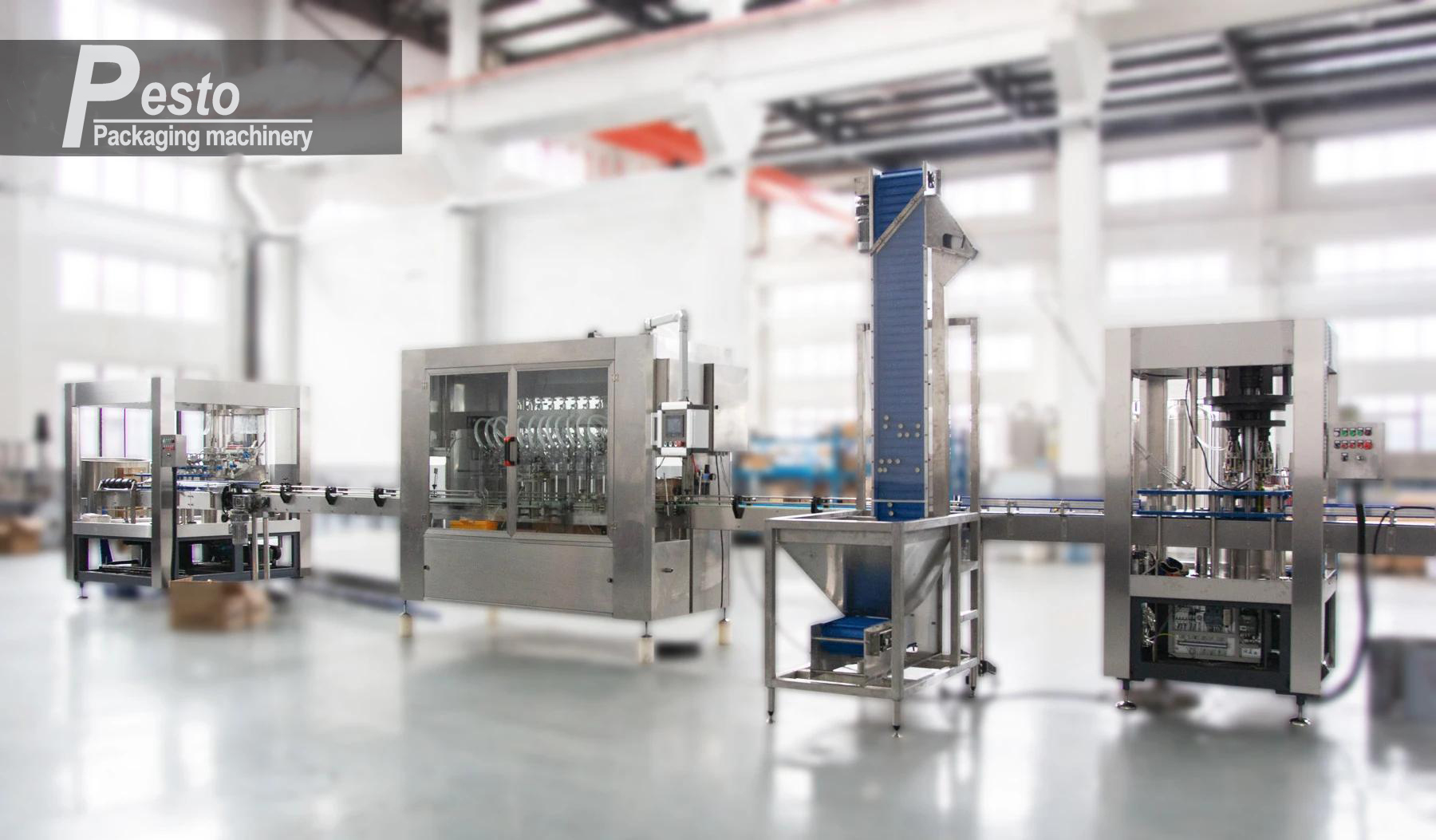
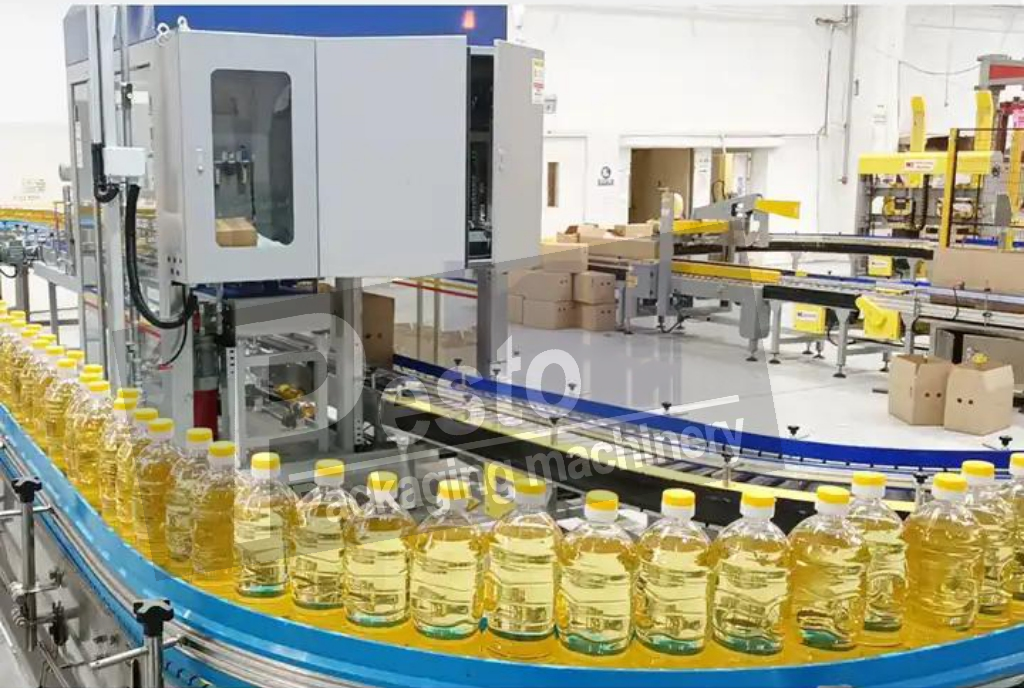
A linear oil filling machine, also called an inline oil filling machine, fills bottles arranged in a straight line along a conveyor.
Empty containers enter the filling station, where they are positioned beneath multiple filling nozzles. Depending on the machine configuration, the bottles may stop during filling or move continuously with a tracking filling system.
After filling, the containers move to downstream equipment for capping, labeling, and packaging.
Linear filling machines can use different dosing technologies, including:
Servo-driven piston filling
Pump-based volumetric filling
Flowmeter-controlled filling
Net-weight filling
The appropriate technology depends on oil viscosity, container volume, required filling accuracy, and production capacity.
PESTOPACK provides oil filling machines designed for different oil products and bottle formats, with configurations customized according to production requirements.
Advantages of Linear Oil Filling Machines
1. Flexible bottle handling
Inline filling systems can accommodate various bottle shapes and sizes through suitable conveyor guides, filling nozzles, positioning devices, and recipe adjustments.
This flexibility is particularly valuable for manufacturers packaging different products in 500 ml, 1 L, 2 L, 4 L, and 5 L containers.
2. Convenient product changeover
Many linear systems provide accessible filling stations and adjustable bottle-handling components.
For factories producing multiple oil products, this can simplify cleaning, format adjustment, and routine maintenance.
3. Lower entry investment in many applications
For comparable small or medium production requirements, a linear machine may require less initial investment than a high-speed rotary system.
However, the actual price depends on the filling technology, automation level, number of filling heads, and auxiliary equipment.
4. Easy integration into modular production lines
Linear filling machines can be combined with bottle feeders, capping machines, labeling machines, induction sealers, carton packing equipment, and conveyors.
This allows manufacturers to develop their production lines in stages.
Limitations of Linear Oil Filling Machines
Linear systems may require a longer conveyor layout, especially when additional filling heads and downstream stations are added.
Their maximum output also depends on the filling cycle, bottle indexing, nozzle count, and product characteristics.
For very high-volume production using standardized containers, a rotary filling system may offer better space utilization and continuous throughput.
What Is a Rotary Oil Filling Machine?
A rotary oil filling machine uses a rotating carousel with multiple filling stations arranged around a circular structure.
Bottles enter the machine through an infeed system, move around the rotating carousel during filling, and exit through a discharge mechanism.
Depending on the machine design, the rotary system can integrate filling with capping or connect to separate downstream packaging equipment.
Rotary oil filling machines are commonly considered when manufacturers require high production capacity, continuous bottle movement, and efficient processing of standardized containers.
A rotary filling machine can operate with many filling stations around a continuously rotating carousel.
This arrangement is particularly suitable for high-volume bottling operations.
2. Continuous production
In many rotary designs, bottles move continuously through the filling process, reducing the repeated acceleration and stopping associated with intermittent inline systems.
3. Efficient use of production space
For a given high output, rotary equipment may provide a compact filling footprint compared with a long inline machine.
However, the complete line layout must also account for bottle feeding, capping, labeling, maintenance access, and material handling.
4. Suitable for standardized production
Rotary systems can be especially effective when a factory produces large quantities of oil in consistent bottle sizes.
Limitations of Rotary Oil Filling Machines
Rotary systems can require more specialized bottle-handling components, such as star wheels, guide rails, and change parts.
When bottle formats vary significantly, mechanical adjustments and replacement components may be necessary.
Higher-speed rotary equipment may also involve a larger initial investment and more demanding maintenance requirements.
Rotary vs Linear Oil Filling Machines: Key Differences
The following comparison highlights the practical differences between rotary and linear oil filling equipment.
Comparison Factor
Linear Oil Filling Machine
Rotary Oil Filling Machine
Machine structure
Straight conveyor with inline filling stations
Circular carousel with multiple filling stations
Production capacity
Commonly small to medium, with higher-output designs available
Commonly medium to high, especially for standardized production
Bottle movement
Intermittent or continuous tracking, depending on design
Usually continuous carousel movement
Initial investment
Often lower at modest production speeds
Often higher for high-speed systems
Bottle changeover
Generally flexible for different formats
May require dedicated change parts
Factory layout
Typically elongated
Compact carousel, with space needed for transfers and servicing
Maintenance
Filling stations often easily accessible
More complex rotating and transfer mechanisms
Filling accuracy
Depends on dosing technology and controls
Depends on dosing technology and controls
Best application
Flexible production with multiple SKUs
High-volume production with standardized bottles
Future expansion
Modular upgrades may be possible
Capacity depends on carousel and machine design
Important: Filling accuracy is not inherently determined by whether the machine is linear or rotary. The dosing system, calibration, product viscosity, temperature, filling valves, and operating conditions are more important.
Likewise, neither design is automatically faster or cheaper in every application.
Production Capacity: Which Machine Is Faster?
Rotary filling machines are generally preferred when the production target becomes sufficiently high to justify a continuous multi-station carousel.
For example, PESTOPACK's published linear lubricant oil filling machine configurations cover approximately 1,000–4,000 bottles per hour, depending on bottle size and filling-head configuration.
Its rotary oil bottling machine product range lists configurations from 2,000 to 20,000 bottles per hour.
These are product-specific published ranges, not universal limits for all linear or rotary filling machines.
Actual achievable capacity must be confirmed using the customer's oil, bottle, cap, and complete line configuration.
Which Machine Is Better for Edible Oil Filling?
Edible oil manufacturers often package sunflower oil, soybean oil, palm oil, coconut oil, olive oil, and vegetable oil in different container sizes.
The selection of filling equipment depends on production volume, bottle format, product characteristics, and cleaning requirements.
When to Choose a Linear Edible Oil Filling Machine
A linear system is often suitable when:
The factory produces several types of edible oil.
Bottle sizes change frequently.
Production requirements are moderate.
Operators need convenient access for cleaning.
The business plans to expand its packaging line gradually.
For example, a manufacturer producing sunflower oil in 1 L bottles and palm oil in 5 L containers may benefit from the flexibility of an inline filling system.
A suitable edible oil filling machine can be configured with appropriate filling technology, contact materials, and bottle-handling equipment.
When to Choose a Rotary Edible Oil Filling Machine
A rotary system may be preferable when:
The factory operates high-volume production.
Most bottles use standardized shapes and sizes.
The production schedule involves long, continuous runs.
Higher initial investment is justified by expected output.
The overall line is designed for high-speed filling, capping, and packaging.
For large edible oil producers, the production efficiency of the entire bottling line matters more than the filling machine's theoretical maximum speed.
Which Machine Is Better for Lubricant Oil Filling?
Lubricant oil packaging presents additional challenges because products can vary in viscosity, container design, and filling requirements.
Common applications include engine oil, motor oil, gear oil, hydraulic oil, and industrial lubricants.
Lubricant manufacturers also frequently use irregularly shaped HDPE bottles and jerrycans, particularly for 1 L, 4 L, and 5 L packaging.
Linear Filling Machines for Lubricant Oil
Linear filling systems are widely used for lubricant packaging because they can accommodate different container formats and dosing technologies.
For example, servo piston filling systems can provide controlled volumetric dosing for viscous products, while weight-based systems may be appropriate for larger containers.
PESTOPACK's lubricant oil filling machine is available with different filling-head configurations for automatic lubricant packaging.
For manufacturers producing multiple engine oil grades and bottle sizes, the flexibility of an inline system can be particularly useful.
Rotary Filling Machines for Lubricant Oil
Rotary machines can also be used for lubricant oil packaging, especially where production volumes are high and bottle formats remain consistent.
However, manufacturers should evaluate the bottle transfer system carefully.
Irregular bottle shapes, integrated handles, and different neck positions may require customized star wheels, guides, or bottle-handling components.
The choice should also consider product viscosity, anti-drip performance, and the required filling technology.
For projects involving several container sizes and downstream equipment, a complete lubricant oil filling line should be evaluated as an integrated system rather than selecting the filler alone.
How Does Filling Technology Affect Machine Performance?
The machine layout is only one part of the equipment selection process.
Filling technology plays a major role in determining accuracy, viscosity compatibility, filling speed, and maintenance requirements.
Servo Piston Filling
Servo piston filling systems use controlled piston movement to dispense a defined volume of product.
They are commonly used for oils and other viscous liquids.
Advantages include controlled dosing, adjustable filling volumes, and suitability for a range of bottle sizes.
Pump Filling
Pump filling systems transfer liquid through a controlled pumping mechanism.
Different pump technologies are suitable for different oil characteristics and viscosity ranges.
Pump selection should account for product compatibility, cleaning requirements, flow control, and the risk of leakage or dripping.
Net-Weight Filling
Net-weight filling systems measure the product quantity using load cells.
They can be especially useful for larger containers such as 20 L pails and 200 L drums, where filling by weight may be preferred.
Key takeaway: A well-designed linear machine can provide excellent filling accuracy, while a properly configured rotary machine can achieve comparable accuracy. The dosing system and process conditions must be evaluated separately from the machine layout.
How to Choose the Right Oil Filling Machine for Your Factory
Before requesting a quotation, manufacturers should evaluate the following factors.
1. Required Production Capacity
Start with your target output in bottles per hour.
For example, a factory requiring 2,000 bottles per hour may have several viable equipment configurations.
A factory targeting much higher output may need to consider a rotary system or a specially engineered high-speed inline solution.
2. Bottle Sizes and Shapes
Confirm whether the production line will handle round PET bottles, square HDPE bottles, handled jerrycans, or other container designs.
Provide bottle drawings or physical samples when possible.
3. Oil Characteristics
Different oils have different flow properties.
Viscosity, temperature, foaming behavior, and product compatibility should be evaluated before selecting the filling system.
4. Changeover Frequency
If the factory frequently changes products or bottle sizes, consider the time required for cleaning, recipe adjustments, nozzle positioning, and mechanical format changes.
The fastest machine at a single bottle size may not provide the highest overall production efficiency when frequent changeovers are required.
5. Available Factory Space
A rotary filling machine may have a compact carousel, while a linear machine may require a longer straight conveyor.
However, the full layout should include space for bottle feeding, capping, labeling, packaging, maintenance, and operator access.
6. Total Investment and Operating Costs
Do not compare filling machine prices alone.
Consider:
Filling equipment
Capping and labeling machines
Conveyor systems
Bottle and cap feeding
Packaging equipment
Installation and commissioning
Spare parts and maintenance
Utilities and labor requirements
The most economical choice is the configuration that meets your actual production requirements with an acceptable total cost of ownership.
Example: Choosing Between Linear and Rotary Filling Systems
A lubricant manufacturer plans to fill 1 L, 4 L, and 5 L HDPE bottles.
The factory expects frequent bottle changeovers and requires flexible production scheduling.
In this situation, a linear filling system may offer practical advantages because of its adjustable bottle handling and accessible filling stations.
Project B: High-Volume Edible Oil Bottling
An edible oil producer plans to package a standardized 1 L PET bottle for long production runs.
The factory prioritizes high output and continuous operation.
A rotary filling machine may be worth considering because its carousel design supports continuous high-volume processing.
These examples illustrate selection principles rather than guaranteed performance. Final machine recommendations require actual product and packaging specifications.
Why Choose PESTOPACK for Oil Filling Equipment?
PESTOPACK provides customized oil filling and packaging equipment for edible oil, lubricant oil, and other compatible liquid products.
Our solutions can include:
Automatic oil filling machines
Bottle feeding and conveyor systems
Automatic capping equipment
Labeling machines
Induction sealing equipment where required
Carton packing and end-of-line automation
Production line layout and technical support
We help customers evaluate machine configurations based on product characteristics, bottle specifications, required capacity, and factory conditions.
Whether you are considering a flexible linear system or a high-capacity rotary solution, our team can assist with equipment selection and complete line integration.
Frequently Asked Questions
1. What is the main difference between rotary and linear oil filling machines?
A linear filling machine arranges filling stations along a straight conveyor, while a rotary filling machine uses a circular carousel. Linear systems are often preferred for flexible production, while rotary systems are commonly selected for higher-volume standardized bottling.
2. Is a rotary oil filling machine faster than a linear machine?
Rotary machines often have an advantage at high production volumes because they can use multiple continuously operating filling stations. However, actual speed depends on machine design, nozzle count, oil viscosity, bottle size, and filling volume.
3. Which machine provides better filling accuracy?
Neither machine layout automatically guarantees better accuracy. Filling accuracy depends mainly on the dosing technology, control system, calibration, product characteristics, and operating conditions.
4. Which machine is better for 1 L and 5 L oil bottles?
Both technologies may be suitable. A linear machine is often practical when manufacturers use multiple bottle sizes or irregularly shaped containers. A rotary machine may be attractive for high-volume production using standardized bottles.
5. Can one oil filling machine handle edible oil and lubricant oil?
Certain filling technologies can be configured for either application, but edible oil and lubricant oil should not share product-contact equipment without an appropriately engineered cleaning and contamination-control system. Dedicated equipment is generally preferable where food safety and cross-contamination risks cannot be reliably controlled.
6. Which machine is more economical?
For small and medium production volumes, linear machines often have a lower initial investment. At higher production volumes, rotary machines may offer better productivity. A proper comparison should consider total investment, labor, maintenance, changeover time, and expected annual output.
7. Can a linear oil filling machine be upgraded later?
Some linear machines allow additional filling heads, automation upgrades, or integration with new packaging equipment. However, upgrade options depend on the original machine structure, control system, and available production space.
Conclusion: Rotary or Linear Oil Filling Machine?
There is no single best oil filling machine for every manufacturer.
Choose a linear oil filling machine when flexibility, multiple bottle formats, accessible maintenance, and moderate production capacity are your main priorities.
Consider a rotary oil filling machine when high output, standardized packaging, and continuous production are more important.
The final decision should also account for filling technology, product viscosity, bottle design, available space, and total investment.
PESTOPACK can help you compare suitable configurations and develop a customized oil filling and packaging solution.
Get a Customized Oil Filling Machine Proposal
Planning a new edible oil or lubricant oil bottling line?
Send us the following information:
Type of oil
Bottle sizes and shapes
Required bottles per hour
Cap type
Available factory dimensions
Required packaging equipment
Our team will help you evaluate the most suitable filling machine configuration for your project.

 العربية
 English
 Français
 Русский
 Español
 Português
 Tiếng Việt
 ไทย
 Polski
 Türkçe
 አማርኛ
 ဗမာစာ
 தமிழ்
 Filipino
 Bahasa Indonesia
 magyar
 Română
 қазақ
 हिन्दी
 فارسی
 Kiswahili
 українська
 Հայերեն
 עברית
 বাংলা
 සිංහල
 Oʻzbekcha
 Azərbaycan dili
 Български
 ქართული
 guarani
 ગુજરાતી
 Hausa
 Igbo
 ಕನ್ನಡ
 Kinyarwanda
 Kurdî
 Кыргызча
 Oluganda
 മലയാളം
 मराठी
 Afaan Oromoo
 ਪੰਜਾਬੀ
 Runasimi
 chiShona
 Soomaali
 Тоҷикӣ
 తెలుగు
 ትግንያውያን
 Türkmençe
 Yorùbá
 isiZulu