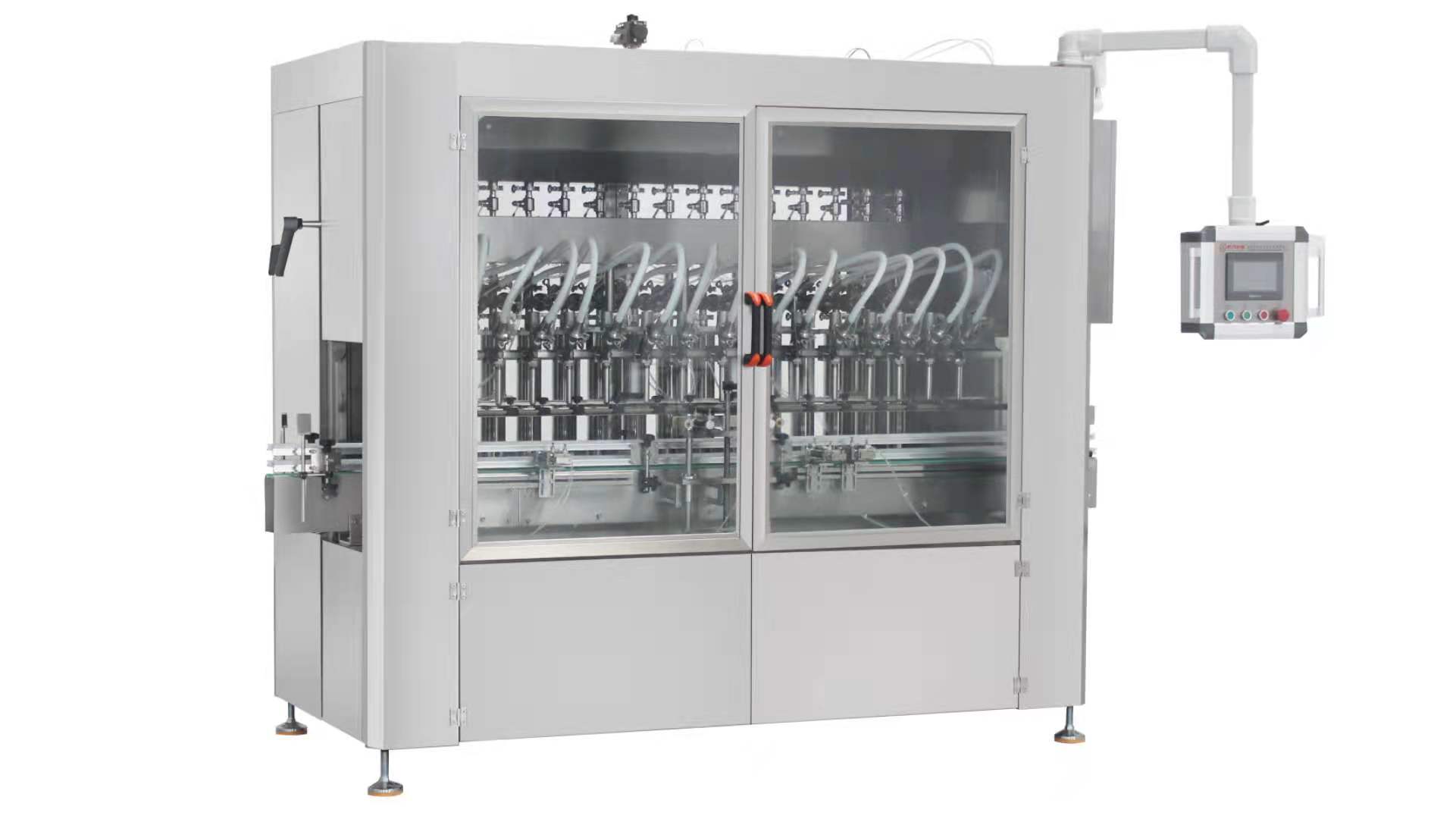
Automatic vs Semi-Automatic Lubricant Oil Filling Machine: Which Is Better?
Views: 0
If you are planning a new lubricant packaging plant—or upgrading an existing one—you will eventually face an important question:
Should you buy an automatic or semi-automatic lubricant oil filling machine?
At first glance, the answer may seem obvious. Automatic equipment is faster, so it must be better, right?
Not necessarily.
A small lubricant producer filling a few hundred bottles per day has very different needs from a factory producing thousands of 1L and 4L engine oil bottles every hour. Buying too much automation increases your initial investment. Buying too little can create labor bottlenecks and make expansion expensive later.
The right choice depends on your production capacity, bottle sizes, lubricant viscosity, labor cost, number of SKUs, available factory space and future growth plans.
This guide compares automatic and semi-automatic lubricant oil filling equipment from a practical production perspective and explains how to choose the right lubricant oil filling machine for your factory.
What Is a Lubricant Oil Filling Machine?
A lubricant oil filling machine is equipment designed to accurately dispense engine oil, motor oil, gear oil and other lubricants into bottles, jerry cans, pails or drums.
Unlike water, lubricants can have significantly different viscosities. Their flow characteristics may also change with product formulation and temperature.
That means choosing an oil filler is not simply a question of how many bottles it can fill per hour.
You also need to consider:
Product viscosity
Filling volume
Container size and shape
Required filling accuracy
Dripping control
Number of products or SKUs
Changeover frequency
Production capacity
Downstream capping and labeling
Common lubricant filling technologies include servo piston filling, magnetic pump filling and net-weight filling.
For example, piston filling is commonly used for viscous lubricants packaged in smaller bottles, while weight filling is particularly useful for larger pails and drums. Magnetic pump systems can offer flexible volume adjustment for suitable low-to-medium viscosity applications.
The filling technology should therefore be selected before deciding how much automation you need.
What Is a Semi-Automatic Lubricant Oil Filling Machine?
A semi-automatic lubricant oil filling machine automates the actual dosing process but still relies on operators for some bottle-handling operations.
A typical cycle looks like this:
An operator places empty containers under the filling nozzles.
The operator activates the filling cycle.
The machine measures and dispenses the preset quantity of lubricant.
The operator removes the filled containers.
Capping, labeling or packing may be performed separately.
Depending on the application, the machine may use piston, pump or weight-based filling technology.
Advantages of Semi-Automatic Lubricant Oil Filling Machines
The most obvious advantage is lower initial investment.
For a startup or a company testing a new lubricant product, it may not make financial sense to install a complete automated line immediately.
Semi-automatic equipment also tends to be:
Simpler to operate
Easier to install
Compact
Easier to relocate
Suitable for small batches
Flexible for frequent product changes
Imagine a lubricant company producing ten specialty products, but only a few hundred containers of each per production run. In this situation, flexibility may matter more than maximum speed.
Limitations of Semi-Automatic Filling
The trade-off is labor dependence.
An operator must continuously load and unload containers, and additional workers may be needed for:
Cap placement
Capping
Induction sealing
Labeling
Carton packing
As production volume increases, these manual operations can become bottlenecks.
The filling machine itself may be able to work faster, but the overall production process cannot exceed the speed of its slowest manual step.
That is why a semi-automatic machine that works well at startup can eventually become expensive in terms of labor per bottle.
What Is an Automatic Lubricant Oil Filling Machine?
An automatic lubricant oil filling machine integrates filling into a conveyor-based production process.
Empty bottles arrive automatically at the filling station. Sensors detect their position, the machine performs the filling cycle, and filled bottles continue downstream without operators manually moving each container.
Modern automatic systems commonly use PLC and HMI control, allowing operators to manage parameters such as filling volume and production recipes.
PESTOPACK, for example, offers automatic lubricant filling configurations using multiple filling heads for different production requirements. Its current automatic lubricant filling equipment is designed for applications including 500 ml to 5 L containers, with the final speed depending on bottle volume, filling-head configuration and product characteristics.
Automatic Filling Is Only One Part of Automation
This distinction is important.
An automatic lubricant oil filling machine does not necessarily mean that your entire factory is automated.
This line-level view matters because installing a fast filler while keeping every downstream operation manual simply moves the bottleneck somewhere else.
Automatic vs Semi-Automatic Lubricant Oil Filling Machine: Quick Comparison
Factor
Semi-Automatic
Automatic
Initial investment
Lower
Higher
Production capacity
Low to moderate
Moderate to high
Labor requirement
Higher
Lower per unit produced
Bottle handling
Mainly manual
Conveyor-based
Filling consistency
Controlled dosing
Controlled dosing with automated bottle handling
Capping integration
Usually separate
Can be integrated
Labeling integration
Usually separate
Can be integrated
Factory space
Smaller
Larger
Installation complexity
Lower
Higher
Small-batch flexibility
Very good
Good when properly configured
High-volume production
Limited
Better suited
Future scalability
More limited
Better
Best suited for
Startups, low volume, specialty batches
Growing and established lubricant manufacturers
So, which one wins?
There is no universal winner.
The better machine is the one that matches your actual production economics.
1. Production Capacity: How Many Bottles Do You Really Need?
Capacity should usually be the first consideration.
Suppose you need 10,000 bottles per day.
If your factory operates one eight-hour shift, the theoretical average requirement is:
10,000 ÷ 8 = 1,250 bottles per hour
But you should not select a machine rated at exactly 1,250 BPH.
Why?
Real factories experience:
Bottle changeovers
Product changeovers
Cleaning
Cap replenishment
Label replenishment
Minor stops
Maintenance
Operator breaks
Your required machine capacity should therefore include a reasonable production margin.
For small production volumes, a semi-automatic solution may be sufficient.
Once demand reaches thousands of bottles per hour, automatic bottle conveying, filling and downstream packaging become increasingly important.
PESTOPACK's current automatic lubricant oil filling machine configurations, for example, cover different filling-head arrangements and are designed for approximately 1,000–4,000 BPH applications depending on bottle size and configuration.
The key lesson is simple:
Do not buy speed based on a brochure. Calculate speed from your actual daily output.
2. Labor Cost: Look Beyond the Machine Price
A semi-automatic machine is cheaper to purchase, but purchase price is only part of your total cost.
Consider two factories.
Factory A uses inexpensive local labor and produces small batches.
Factory B operates in a market with high labor costs and runs long production shifts.
Even if both factories produce the same lubricant, their ideal automation levels may be completely different.
When comparing equipment, calculate:
Annual labor cost = number of operators × labor cost per operator × operating period
Then compare that figure over several years.
Automatic equipment may require a higher upfront investment, but it can reduce repetitive bottle handling and the number of operators required per unit of output.
Conversely, if production demand is low, the labor savings may not justify the additional automation.
3. Filling Accuracy and Product Loss
Lubricant is more valuable than water, so small overfills can become meaningful over millions of bottles.
Consider a hypothetical example.
If every bottle receives only 5 ml more product than required and you produce one million bottles, the total excess is:
5 ml × 1,000,000 = 5,000 liters
That is product you manufactured but did not sell separately.
This is why filling accuracy should be evaluated carefully.
However, it is incorrect to assume that a machine is accurate simply because it is automatic.
Accuracy depends heavily on:
Filling principle
Dosing system
Product viscosity
Temperature
Calibration
Machine design
Filling volume
For lubricant applications, the correct filling technology is often more important to accuracy than the automation label itself.
4. Bottle Sizes and Changeovers
Lubricant factories rarely produce just one package size.
A typical portfolio might include:
500 ml
1 L
4 L
5 L
20 L
Bulk industrial products may also use much larger drums.
Ask your machine supplier:
Can the same machine handle all my required containers?
And equally important:
How long does changeover take?
An automatic machine can be highly flexible when guides, filling parameters and downstream equipment are designed around multiple formats. PLC recipe storage can also simplify repeated changeovers.
But if you have dozens of low-volume SKUs and change bottle formats constantly, a simpler semi-automatic setup may sometimes offer greater operational convenience.
This is why bottle samples and drawings should be provided before equipment selection.
5. Lubricant Viscosity Matters
Not all lubricants behave the same way.
Engine oil, gear oil and other industrial lubricants may have different flow characteristics.
This affects both filling speed and filling technology.
Servo Piston Filling
Servo piston systems are well suited to many viscous oil applications. The piston meters a controlled volume and provides stable volumetric filling.
They are commonly considered for bottles such as 1 L, 4 L and 5 L.
Magnetic Pump Filling
Magnetic pump filling provides convenient electronic adjustment and can work effectively with appropriate low-to-medium viscosity lubricants.
It is useful where flexible volume control and clean filling are priorities.
Net-Weight Filling
For large containers such as 20 L pails and 200 L drums, net-weight filling is often attractive because the dosing process is based on measured weight.
PESTOPACK's lubricant packaging solutions use different filling technologies according to container size, viscosity and required production capacity rather than applying one filling method to every project.
6. Capping, Labeling and Packaging Can Change the Decision
This is where many buyers make a mistake.
They compare only two filling machines.
But what happens immediately after filling?
If your automatic filler produces 3,000 bottles per hour while workers manually place and tighten caps at a much lower rate, you do not really have a 3,000-BPH production line.
For this reason, medium and large manufacturers should evaluate the complete lubricant oil filling line, not just the filler.
A balanced line is more important than having one exceptionally fast machine.
7. Factory Space and Layout
Semi-automatic machines have an obvious advantage when space is limited.
You may only need room for:
Filling machine
Working tables
Capper
Labeling station
Finished-product handling
A complete automatic line requires more space for conveyors, buffer sections, capping, labeling and packing equipment.
But do not assume that a smaller machine always means a better layout.
Manual bottle movement also requires working space.
Operators need safe access to containers, caps, cartons and finished products.
Before ordering equipment, prepare an accurate factory drawing showing:
Length
Width
Ceiling height
Columns
Doors
Drainage
Electrical points
Compressed-air supply
Raw-material area
Finished-product area
A line layout can then be designed around the building instead of discovering after delivery that the equipment does not fit efficiently.
8. Maintenance and Technical Complexity
Semi-automatic equipment generally has fewer integrated systems, making maintenance relatively straightforward.
Automatic lines contain more:
Sensors
PLC controls
Servo systems
Pneumatic components
Conveyors
Motors
Safety devices
This means maintenance capability becomes more important.
However, more automation does not automatically mean unreliable operation.
A well-designed automatic line with accessible components, proper documentation and trained operators can provide stable long-term production.
Before purchasing, ask about:
Recommended spare parts
Preventive maintenance
Electrical component brands
Remote technical support
Operator training
Installation support
These factors often matter more over ten years than a small difference in the initial machine price.
9. Initial Cost vs Long-Term ROI
Instead of asking:
“Which machine is cheaper?”
Ask:
“Which system gives me the lowest reasonable cost per bottle at my production volume?”
Your investment calculation should include:
Cost Factor
Semi-Automatic
Automatic
Equipment investment
Lower
Higher
Operators
More
Fewer per unit of output
Conveyor investment
Limited
Higher
Installation
Simpler
More involved
Production capacity
Lower
Higher
Expansion potential
More limited
Better
Manual handling
Higher
Lower
Long-term unit economics
Depends on volume
Improves as utilization increases
There is no meaningful ROI calculation without your production data.
A machine running at 20% utilization is not automatically a good investment simply because it is technologically advanced.
When Should You Choose a Semi-Automatic Lubricant Oil Filling Machine?
A semi-automatic system is worth considering when:
You are starting a new lubricant business.
Your daily output is relatively low.
You manufacture specialty lubricants in small batches.
You change products frequently.
Labor is readily available.
Factory space is limited.
Initial capital expenditure needs to stay low.
You want to validate demand before expanding.
For these users, simplicity can be an advantage rather than a compromise.
When Should You Choose an Automatic Lubricant Oil Filling Machine?
Automatic equipment becomes more attractive when:
Production demand is consistently high.
You need thousands of bottles per shift.
Labor costs are significant.
Filling is part of a continuous production process.
Consistent throughput is important.
You want automatic capping and labeling.
Your business is expanding.
You need a scalable production system.
In these cases, the better question may not be whether to automate the filler, but how much of the entire packaging process should be automated.
Automatic Machine or Complete Lubricant Oil Filling Line?
There is an important difference between these two investments.
If you already have a suitable capper, labeler and conveyor system, upgrading only the filler may make sense.
For a new factory, however, designing the complete line together can reduce integration problems.
A complete PESTOPACK lubricant oil filling line can be configured around the required process, including filling, capping, labeling and packing equipment.
The final configuration should be based on the actual product and production requirement rather than a standard package.
How PESTOPACK Configures a Lubricant Oil Filling Solution
There is no single lubricant filler that is ideal for every factory.
Before configuring a project, the following information is particularly useful:
1. What lubricant are you filling?
Engine oil? Gear oil? Industrial lubricant?
Product viscosity and characteristics influence the filling method.
2. What are your container sizes?
Provide every required volume—not only your main bottle.
For example:
500 ml / 1 L / 4 L / 5 L / 20 L.
3. What production capacity do you need?
Specify bottles per hour or daily production volume.
4. What do the bottles and caps look like?
Bottle and cap samples, drawings or photographs help determine handling and changeover requirements.
5. What happens after filling?
Do you require:
Automatic capping?
Induction sealing?
Labeling?
Coding?
Carton packing?
Palletizing?
PESTOPACK can then determine whether the project needs an individual lubricant oil filling machine or a more integrated production line.
FAQ About Automatic and Semi-Automatic Lubricant Oil Filling Machines
Is an automatic lubricant oil filling machine more accurate than a semi-automatic machine?
Not necessarily. Filling accuracy depends primarily on the dosing technology, machine design, calibration, lubricant characteristics and operating conditions. Automation mainly reduces manual container handling and allows the filler to integrate more efficiently with other packaging equipment.
What filling machine is best for thick lubricant oil?
Servo piston filling is commonly used for viscous lubricants because it provides controlled volumetric dosing. The final selection should be based on actual viscosity, filling volume, temperature and required capacity.
Can one lubricant oil filling machine fill different bottle sizes?
Yes, many machines can handle multiple bottle sizes within their designed range. However, guides, filling parameters and sometimes change parts must be adjusted. Always provide all bottle dimensions before the machine is designed.
Can I start semi-automatic and upgrade later?
Yes, but plan the upgrade path before purchasing. Ask whether the filler can later connect with conveyors, automatic capping and labeling equipment. In some cases, buying a completely different automatic system later may be more practical than modifying equipment that was never designed for integration.
How fast is an automatic lubricant oil filling machine?
There is no universal speed. Output depends on filling volume, viscosity, filling-head quantity, bottle handling and machine configuration. PESTOPACK's current automatic configurations include approximately 1,000–4,000 BPH solutions for relevant bottle applications, while complete lubricant lines can be engineered for different capacity requirements.
Do I need a complete lubricant oil filling line?
Not always. A standalone filler can be sufficient for small production or an existing factory with downstream equipment. New or higher-volume plants should evaluate filling, capping, labeling and packing together to avoid production bottlenecks.
So, Which Is Better: Automatic or Semi-Automatic?
Neither is universally better.
Choose semi-automatic when flexibility, low initial investment and small-batch production are your priorities.
Choose automatic when throughput, reduced manual handling, line integration and future scalability are more important.
Most importantly, do not select a lubricant oil filling machine based only on its advertised speed or price.
That sequence leads to a much more sensible equipment decision.
If you are planning a lubricant packaging project, provide PESTOPACK with your lubricant type and viscosity, bottle sizes, bottle and cap photos, required BPH and packaging requirements. From there, the filling technology, automation level and complete line configuration can be matched to your actual production needs rather than forcing your factory around a standard machine.

 العربية
 English
 Français
 Русский
 Español
 Português
 Tiếng Việt
 ไทย
ไทย Polski
 Türkçe
 አማርኛ
አማርኛ ဗမာစာ
ဗမာစာ தமிழ்
தமிழ் Filipino
 Bahasa Indonesia
 magyar
 Română
 қазақ
қазақ हिन्दी
 فارسی
فارسی Kiswahili
 українська
 Հայերեն
 עברית
עברית বাংলা
বাংলা සිංහල
සිංහල Oʻzbekcha
 Azərbaycan dili
 Български
 ქართული
 guarani
 ગુજરાતી
 Hausa
Hausa Igbo
Igbo ಕನ್ನಡ
ಕನ್ನಡ Kinyarwanda
 Kurdî
Kurdî Кыргызча
 Oluganda
 മലയാളം
 मराठी
मराठी Afaan Oromoo
 ਪੰਜਾਬੀ
 Runasimi
 chiShona
 Soomaali
 Тоҷикӣ
 తెలుగు
 ትግንያውያን
 Türkmençe
 Yorùbá
 isiZulu